Choosing the right backend technology is one of the most important decisions in web development. Two popular choices today are Laravel (PHP framework) and Node.js (JavaScript runtime). Both have strong communities, powerful features, and real-world use cases.
In this blog, we’ll compare Laravel and Node.js across key factors like performance, security, scalability, and developer experience to help you decide which one fits your project best.
Overview: Laravel vs Node.js
Laravel:
- Language: PHP
- Type: Full-stack MVC framework
Node.js::
- Language: JavaScript
- Type: Runtime environment (commonly used with Express.js)
- Best for: Real-time, scalable applications
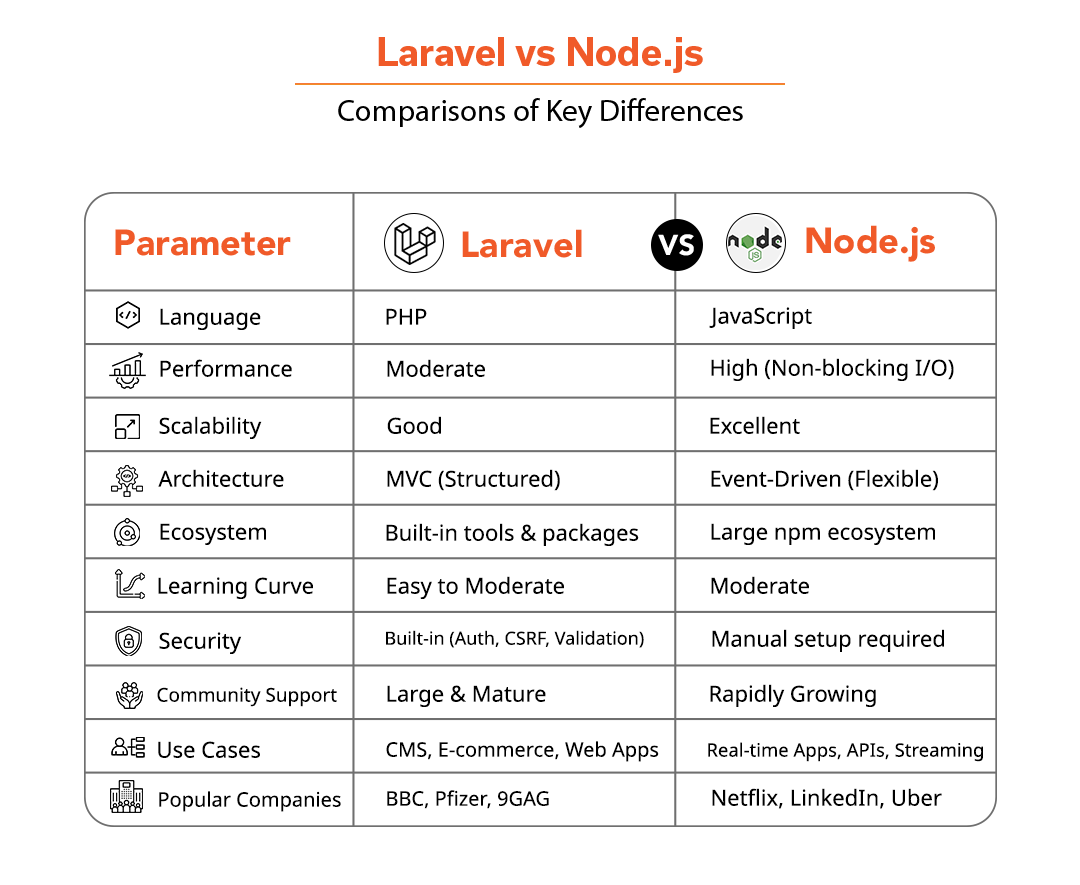
Comparison of Laravel and Node.js across performance, security, and scalability.
Language Difference
Laravel uses PHP, a server-side scripting language widely used for web development.
Node.js uses JavaScript, allowing developers to use the same language for both frontend and backend.
Framework & Structure
Laravel comes with a built-in MVC architecture, routing, authentication, and many features out of the box.
Node.js (with Express.js) is minimal and flexible, requiring developers to structure the project manually.
Performance & Speed
Laravel: Moderate performance due to synchronous execution model.
Node.js: High performance thanks to its non-blocking, event-driven architecture.
Security
Laravel provides built-in security features like:
- Authentication system
- CSRF protection
- SQL injection prevention
- Password hashing
Node.js requires manual implementation of:
- Authentication
- Security middleware
- Data validation
Laravel wins in out-of-the-box security.
Community & Ecosystem
Laravel has a strong and mature PHP community.
Node.js has a rapidly growing ecosystem driven by JavaScript developers.
Laravel: Pros & Cons
Pros
- Elegant and readable syntax
- Built-in MVC architecture
- Strong security features
- Fast prototyping and development
Cons
- Slightly slower performance
- Can feel heavy for small APIs
Node.js: Pros & Cons
Pros
- High performance and scalability
- Real-time capabilities (WebSockets, streaming)
- Same language for frontend and backend
Cons
- Requires manual setup for structure
- Security must be handled carefully
- Can become complex in large-scale apps without proper architecture
When to Use Laravel vs Node.js
Choose Laravel if:
- You want fast development with built-in features
- Your app requires strong security out of the box
- You prefer a structured MVC architecture
Choose Node.js if:
- You are building real-time applications (chat apps, live dashboards)
- You need high scalability and performance
- You want to use JavaScript across the entire stack
Conclusion
Both Laravel and Node.js are powerful in their own ways. Laravel excels in developer experience and built-in features, while Node.js shines in performance and real-time capabilities.
Understanding their strengths will help you choose the right tool and build better applications.